Wednesday, 31 August 2016

Special interest group: Rua Tekau

Today we looked at Maths all around us and came up with a list of what we saw, we will add to this list.

We discussed how we measure different objects for volume and mass. Cubic metres was a new term for our group. 

We discussed what we like people to say and do when working in our maths groups. 
Key ideas:
Talking together, being listened to, recognising our strategies, giving hints or tips but not the actual answer. Giving build ups. 
These will be our group rules during maths time. 

We also recognised everyone learns differently and sees patterns differently. 
(The dot card visual task). 
If shown this for three seconds, how do know how many dots there are? 


We were also given a problem to work in our groups. 

Tekau Ma Ono

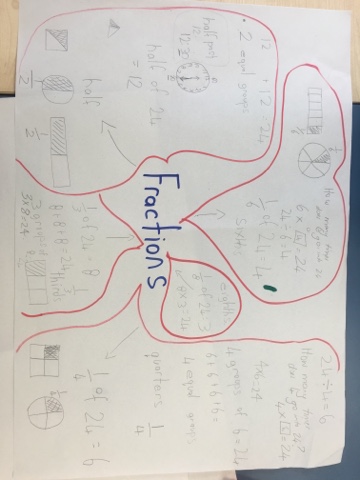
Understanding the links between multiplication and division. 


Thursday, 25 August 2016

Rua Tekau Ma rua

Drawing phone batteries to show percent is a winner today!! 


Wilmer is showing us what 50% looks like in variety of ways. 
Brayden used the computer battery to help him show and understand percent. 
Tim could simplify the fraction from 4/6 to 2/3rds.  He also showed it in a variety of ways. 


Tuesday, 23 August 2016

Monday, 22 August 2016

MATHS WEEK 2 EQUATIONS:

Congratulations Room 21 for putting up the most equations for this question!!!


7 is the answer.  

What is the question/equation?


Answers:

Making mountains could be one way to illustrate it visually.  You could talk about the king of the mountain (triangle) and how it needs two numbers to reach the top, what could they be?

              7
3 4

Lots of combinations - reinforcing flexibility with Numbers.

This shows "reversibility"
Use the term ‘reversibility’ - two numbers equal the same irrespective of the order ie
3 + 4 = 7 and so does 4 +3 =7.  

This basic Maths Principle can halve the basic facts students need to learn.

0 + 7 =
1 + 6 =
2 + 5 =
3 + 4 =
4 + 3 =
5 + 2 =
6 + 1 =
7 + 0 =

We can move onto more challenging equations like...
Half of 14 is?
14  divided by 2 is?
How many times does 2 go into 14?
21 shared into 3 equal groups is --
One third of 21 is?

Answer:
10 is the fraction of a number what could the number and fraction be?

(experiment with different fractions).


10 is half of 20
So ½ of 20 is 10.

¼ of 40 is 10

Keep going..... please post in the comment box any other equations you may have.
THANK YOU